
Dopamine-Introduction
Dopamine is the primary neurotransmitter that activates the brain’s Limbic “reward” system (though not the only one). When dopamine levels rise, neurons in the reward system are excited, causing the feeling of pleasure. But dopamine is about more than just gratification. It’s also central to learning from it, highlighting pleasurable experiences to remember how to repeat them. That is, to learn from positive experience.
Addictive drugs cause large surges of dopamine in the Limbic system. So drug use not only causes a high, it also has significant impacts on learning, memory and motivation.
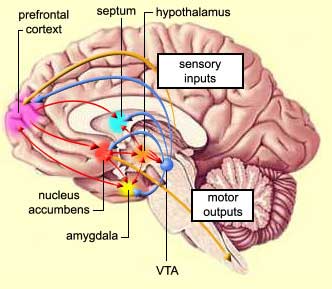
Human brain
For more, click on:
-
Dopamine: Basics
-
Dopamine: Learning, Memory and Motivation
-
Dopamine: A Multi-Functional Molecule
-
Dopamine: Cross-Talk With Other Neurotransmitters
Click here for information about Other (non-dopamine) Neurotransmitters and Addiction.
There is also a Dopamine System not just the limbic system that seem to be associated with the expectation of the drug that seems to be a lot more stronger than the limbic system itself.
You exposition is not bad, and is a good basic explanation of addiction.
Thanks for your comment. You’re right, neuroscientists say there are at least two related dopamine actions in the “reward” system, the “liking” system, which is associated with the feeling of pleasure, and the “wanting” system which is associated with the expectation of reward. Drug abuse can upset the balance between these systems to the point where the “wanting” system overpowers the “liking” one, explaining why addicts continue to be motivated to take drugs long after they have stopped being pleasurable. I cover this briefly in the “Dopamine Basics” and “Dopamine: A Multifunctional Molecule” articles.
[…] Recovery, “All addictive drugs share the same essential experience: a high brought on by spiking dopamine in the brain’s Reward System. So, while there are some differences between alcoholism and drug […]